Well, Jule, you got me looking for the fake palindrome, and I think I have spotted it - the line "blood in my eyes" apparently alludes to a song covered by Bob Dylan and originally performed by the Mississippi Sheiks in the 30s. Here is a link to the lyrics:
I've got blood in my eyes for you
And here is a cover of the song:
Cover by Mitchell Wilson
Mittwoch, 23. März 2011

Montag, 21. März 2011
No doubt about “Doubt” – A Review for www.tbajournal.com
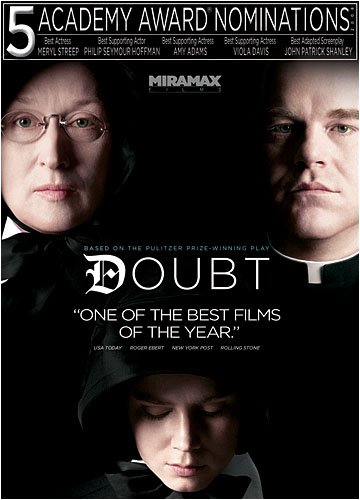
„What do you do when you are not sure? “ Uncertainty or doubt may have followed each of us at some point in their life, but the kind of doubt that we are dealing with here, is no to be compared with our petty everyday-problems.
Sister Aloysius is certain that Father Flynn has an improper relationship with one of the students at their catholic school, even though she doesn’t have any proof. Sister James, a dewy-eyed and naïve novice, wants to believe that the charismatic and liberal priest only has noble intentions. If there is no proof, how far can you go to pursue your beliefs? This is a highly topical question since the accusations of pederasty in catholic schools have accumulated drastically within the last year. The problem is, that such accusations, even if not true, can destroy a person’s reputation and life completely, which is why one has to be careful before uttering them.
John Patrick Shanley, Author of the play from 2005 and director of the film “Doubt” from 2008 has taken into account every possible point of view. He offers a world inside the catholic school or outside, in the Bronx, where twisted camera angles disrupt the natural order and create an uncertainty in the viewer that can only be compared to a roller-coaster-ride. At the beginning one notices the little hints that something might not be normal about the relationship between Donald and Father Flynn, even though his open-mindedness and warm-heartedness, as opposed to Sister Aloysius’s strict, cold and heartless handling of educational matters, make him the sympathetic figure. At other times, you see a glimpse of concern and love in the behaviour of Sister Aloysius, who is usually bigoted and iron-gloved, that repeatedly show that there is no such thing as black and white and that make all characters ambiguous.

The breathtaking performances of the actors Meryl Streep and Philip Seymour Hoffman are the reason why this film got five Oscar-nominations. Streep plays the shrewd and draconic headmistress so perfectly realistic that one might think she actually occupied a similar position at some point. Her facial expression is so frozen and cold that she could freeze over the Kalahari Desert and her fierce demeanour makes Attila the Hun blush and giggle like a schoolgirl. Hoffman manages to move the viewer when he hugs Donald so far as to make them hope, wish, beg that he is innocent, that this is really just platonic affection. The combination of the two headstrong characters who are constantly battling for position and engaging in vivid and excoriating discussions makes for jaw-dropping scenes that still leave the viewer at see as to who is right and who is wrong.

In my opinion, it is a gross nuisance that this film did not receive a single academy award despite the brilliant script and cast. Possible, the topic was still too much of a taboo for the Academy. A sad fact, especially since the difficulty in “Doubt” arises especially from the tabooing child-molestation in the first place. However, the film was set in the 1960s and one should think that society has moved on since then. If you want to see for yourself what the Academy has missed, how doubts can tear a person and a whole community apart, and how outstanding actors can heighten an already extraordinary play to perfection you must go and see this film.
Catholic Fundamentalist Quarterly

Christian Cinema Monitor: “Doubt”
It is common knowledge that accusations of child abuse within the Roman-Catholic have been the weapon of choice in an atheist smear campaign during the last years. So it is of little surprise that this topic even found its way into the mainstream film industry. The 2008 movie “Doubt” by John Patrick Shanley however chooses a refreshingly accurate approach.
Set in a Catholic school in the Bronx of the 1960s, “Doubt” tells the story of the falsely accused priest Father Flynn (Philip Seymour Hoffman) and his struggle for justice against the paranoid principal Sister Aloysius (Meryl Streep). The film carefully illustrates how the vague suspicions of the fragile young nun Sister James (Amy Adams) in the hands of the vile headmistress transform into a very real threat to the popular Father Flynn, who warm-heartedly looks after the school's first black student Donald (Joseph Foster). Sister Aloysius uses this very warmheartedness against Father Flynn, who has ever been an anathema to her, because of his progressive ideas. These are very same ideas that have transformed our beloved Catholic church into the flawless, modern religion lacking any need for further bettering, that we have today.
In a touching sermon Father Flynn compares the nature of doubt with feathers, that fly from a cut-open pillow on a rooftop – you can never take them back once they have been spread. But Sister Aloysius remains unmoved and continues her campaign. In the end Father Flynn tragically has no further options but to leave the school and abandon little Donald to his isolation. It is not before the closing scene that Sister James finally realizes her manipulation and speaks up against her principal. In the end Sister Aloysius admits her wrong doings and the film ends with a well-deserved nervous breakdown.
In addition to its important statement the film features some outstanding acting by Philip Seymour Hoffman and Meryl Streep. Hoffman convincingly embodies the clever, witty and charming Father Flynn and everyone can see his honest hurt as he is cornered by the vicious Sister Aloysius. Her role on the other side is greatly acted as well: Meril Streep succeed to portray the bitter old woman, who tries to appear caring, but repeatedly fails to hide her stinging irony. Even when she cooly admits that she is “moving away from God” in her behavior and blackmails Father Flynn with her bitter lies, her face remains unmoved and stern – a brilliant personification of a character corrupted by her inner doubts.
The message of the film however is free of any doubt: We must not let the doubts and suspicions of single poisoned minds destroy the reputation of honest men and tear apart our great Catholic church. Thus I will end with quotation from the bible that tells everything we need to know about doubt:
“Truly I tell you, if anyone says to this mountain, ‘Go, throw yourself into the sea,’ and does not doubt in their heart but believes that what they say will happen, it will be done for them.”
Pic via
Childhood Reads - Part I
Last Saturday I found myself in my mother’s basement helping her tidying up the mess that had accumulated in the past few years. While we were deciding what to keep and what to chuck away, I came across six large cardboard boxes filled with all my children’s books. I opened a few of them to have a look at what my mum was guarding like a lioness from being discarded. We have an understanding that all these books are to be kept for a possible next generation, because I always wanted to pass on the love for books that I had had as a child and still feel strongly in every fibre of my body.
Why do children read? Even though the media tries to make us believe that children these days have been completely usurped by television and the internet, when I was a kid, there was nothing I loved more than a good book. From the time when I would read the books out loud to myself, following the text line by line with the tip of my finger, I would get sucked into the world that was hidden between these pages. I could get lost in the stories of remote countries, fantastic worlds and lives that were so completely different from my own. I could never name the one book that influenced my childhood the most, since there were just too many marvelous pieces of fiction that I loved and read over and over again. However, I’m trying to regain a piece of my own childhood by recapitulating which of my favourite books I could still read today.

Like every other child I was a huge fan of anything by Astrid Lindgren but not, like most kids, obsessed with “Pippi Longstocking”. If I had to name my all-time-favourite by Lindgren, it would be “The Brothers Lionheart”.
The books deals with the two brothers Jonathan and Karl, called “Krümel” (crumb), who are as different as two brothers can be. While Jonathan is strong, valiant and good, his little brother Krümel is chronically ill and spends most of his time in bed. He knows that he is going to die soon, so his brother Jonathan tells him the story of a magical land of adventure, campfire and storytelling days called Nangijala, a place you go to after your death.
The books deals with the two brothers Jonathan and Karl, called “Krümel” (crumb), who are as different as two brothers can be. While Jonathan is strong, valiant and good, his little brother Krümel is chronically ill and spends most of his time in bed. He knows that he is going to die soon, so his brother Jonathan tells him the story of a magical land of adventure, campfire and storytelling days called Nangijala, a place you go to after your death.
When a fire breaks out in the house of the family, Jonathan takes Krümel onto his back and jumps out of the window to save him. Jonathan dies in the attempt, Krümel however survives the accident but dies soon after from his unnamed illness (hinted to be tuberculosis). All these events would make the story a tragedy and probably not suitable for children. But as we know Lindgren, this is not the end. Krümel does indeed wake up in Nangijala and is luckily reunited with Jonathan in the fairytale-esque Cherry Valley where Krümel is no longer sick but can roam freely with Jonathan and experience adventures.
However, there are problems in Nangijala and together with a resistance group, Jonathan and Krümel fight against the evil dictator Tengil and his ferocious dragon Katla who are terrorizing the Thorn Rose Valley. They free resistance leader Orvar from Katla’s cave and help the people of the valley dispossess Tengil. Sadly, Jonathan gets hurt by Katla’s fire which will cause him to become paralyzed and die slowly. Jonathan tells Krümel about the land that awaits them beyond: Nangilima. This time it is Krümel’s turn to pick up Jonathan on his back and jump, this time into the abyss of the mountains between the two valleys. The last words of Krümel, who believes every word of his brother’s story, are: "Oh, Nangilima! Yes, Jonatan, yes - I see the light! I see the light!"
The topics that Lindgren touches in her book are difficult to convey in a manner that children can grasp and process: Disease, death, tyranny, betrayal and rebellion. Especially death is a topic that is dark and scary for most children, however, it is not in “The Brothers Lionheart”. Of course, as a child, I cried my eyes out each time Jonathan and Krümel jumped, but I knew that they would be together once they reached the other side, even though I was never quite sure that the second land, Nangilima, actually existed. Even though the book deals with a sad story and has no definite and clear happy ending, I must have read it around twenty times. The ideals presented like loyalty, love, hope, courage and pacifism seem to have spoken to me. I loved they way none of the brothers would ever leave the other, how they fought for their friends and freed everyone in the end. I loved the thrill of the danger that approached when Tengil blew his horn to command his dragon Katla or when he pointed his finger at someone who was then instantly moribund. I loved Jonathan who says he would never kill, not even to defend himself. If I ever have children, this will certainly be one of the books that they will read.
A very moving fact that wikipedia revealed to me: “Vi ses i Nangijala” (“See you in Nangijala”) is sometimes used in Swedish obituaries.
Pic via
Sonntag, 20. März 2011
"Fake Palindromes" - An Attempt at an Analysis

For a definition of fake palindromes or "Famlindromes" check: http://falindrome.com/, the page of Amir Blumenfeld, who is posting a new falindrome each day.
Listen to the song on youtube: http://www.youtube.com/watch?v=8U7xpGi5SsU
"Fake Palindromes" by Andrew Bird
My dewy eyed, Disney bride what has tried
Swapping your blood with formaldehyde
Monsters, whiskey-plied voices cried fratricide
Jesus, don't you know that you coulda died?
You should have died with the monsters what talk
Monsters what walk the earth
And she's got red lipstick, and a bright pair of shoes
And she's got knee high socks, what to cover a bruise
She's got an old death kit, she's been meaning to use
She's got blood in her eyes, in her eyes for you
She's got blood in her eyes for you
Certain fads, stripes and plaids, some singles ads
They run you hot and cold like a rheostat I mean a thermostat
So you bite on a towel, hope it won't hurt too bad
My dewy eyed, Disney bride what has tried
Swapping your blood with formaldehyde
With the monsters what talk, monsters what walk the earth
She says, I like long walks and sci-fi movies
You're six foot tall and East coast bred
Some lonely night we can get together
And I'm gonna tie your wrists with leather
And drill a tiny hole into your head
And I'm gonna drill a tiny hole into your head
Swapping your blood with formaldehyde
Monsters, whiskey-plied voices cried fratricide
Jesus, don't you know that you coulda died?
You should have died with the monsters what talk
Monsters what walk the earth
And she's got red lipstick, and a bright pair of shoes
And she's got knee high socks, what to cover a bruise
She's got an old death kit, she's been meaning to use
She's got blood in her eyes, in her eyes for you
She's got blood in her eyes for you
Certain fads, stripes and plaids, some singles ads
They run you hot and cold like a rheostat I mean a thermostat
So you bite on a towel, hope it won't hurt too bad
My dewy eyed, Disney bride what has tried
Swapping your blood with formaldehyde
With the monsters what talk, monsters what walk the earth
She says, I like long walks and sci-fi movies
You're six foot tall and East coast bred
Some lonely night we can get together
And I'm gonna tie your wrists with leather
And drill a tiny hole into your head
And I'm gonna drill a tiny hole into your head
The song Fake Palindromes by Andrew Bird evokes confused and uncertain feelings in me that I can’t quite pin down.
First of all, its rhyme scheme is unusual since it has a rhyme at the end of each verse in the chorus: “formaldehyde”, “fratricide”, “died”, but also within the first verse: “-eyed”, “bride”, “tried”. This adds to the general feeling of confusion and eeriness.
The vocabulary used conveys a dark, negative picture. This is contrasted with the of the „dewy-eyed disney bride” which might refer to a corruption of innocence through violence. Swapping the blood of a human being with formaldehyde can be seen as a reference to death following the aforementioned killing since it is common to preserve corpses with formaldehyde.
The “monsters that talk, monsters that walk the earth” are, in my opinion, humans. They are monster-like in their character traits but appear to be normal on the outside since they talk and live like normal human beings but are evil on the inside and as scary as monsters.
The next stanza is talking about a woman that is not directly spoken to but only mentioned as “she”. This woman is using make-up and clothing to hide her “bruise”, possibly a metaphor for hiding one’s hurt feelings under a façade of some kind.
The “old death kit” that this woman wants to use could be a weapon of some kind, maybe to get revenge on a partner who left her for whom she has “blood in her eyes”, which means she is shedding blood instead of tears, another dark and obscure image.
The fact that the narrator seemingly addresses some other person could also stem from the fact that another person is narrating here and maybe talking about the “dewy-eyed disney bride” from the chorus as “she” and the “you” might be the narrator of the chorus. If one follows this line of interpretation, the last stanza is told from the same perspective, since it talks about this “she” as well and also a “you”, but it includes the narrator as a third person who wants to kill one or both of them by drilling a “hole in “your” head after tying the wrists of either “you” or “you and her” together, it is not entirely clear who is meant here, but the confusion it creates is deliberate. The listener gets lost in a feeling of unease, danger and violence. Death threats appear twice in the song as well as an allusion to torture: “so you bite on a towel, hope it won’t hurt so hard”.
The song does not seem to tell a coherent story, it rather offers a series of strange and threatening emotions, mostly negative ones. These emotions are lost love and hurt feelings that are combined with motives like homicide, torture and corruption of innocence.
Maybe the title “Fake Palindromes” already points the listener in the right direction, since palindromes are words that can be read forwards and backwards. In this case the palindromes are fake, so they only appear to be readable from both sides. This means that the reader is being deceived because he assumes the given words to be a palindrome and oversees the minor differences. This might imply that the song doesn’t actually have the meaning one wants to see in it, maybe it has no meaning at all but rather conveys certain emotion without actually spelling out a theme behind the words.
Pic via
The National – Fake Empire
The song “fake empire“ by US indie rock band The National was published in 2007. While first listening to that song, it conveys a feeling of happiness and melancholia at the same time.
For me, the song offers a great potential of being interpreted in different ways. Although an interpretation towards a disenchantment of the idea of America is equally possible, I decided on looking into the theme of finding a new love.
The song evokes a purity in the feeling of happiness that you only feel if you have freshly fallen in love with somebody. This is the time, in which you feel like children together, forgetting about everything else and “stay out super late tonight”. You do not care what you do as long as you do it together, like “picking apples, making pies.”
“We’re half awake in a fake empire” shows nonetheless, how you know that the real world is out there and approaching. Your regular lives are not as fun as what you are experiencing when being together. Therefore, your dream world is only a “fake empire”.
When in the state of early love, you are not worrying about what others think about your public displays, you “do your gay ballet on ice.” The second stanza could allude to the “The Wizard of Oz” (“shiny city” and “diamond slippers”), in which the “empire” of Oz was built on the Wizard of Oz who turns out to be a “fake”. The “bluebirds on our shoulders” have a clear Disney-esque happiness to them, but it also accentuates the delusion of the lovers, because it is not their own world, but one surrounded by hyperbolic happiness. You are trying to lie to yourself that you can stay in this cheerfulness, though you know you cannot, you are “half awake”.
You are in such a natural high, in which you postpone the inevitable, you try to ignore it with “no thinking for a little while”. You consciously make an effort not to rush or label things because presently, things are great and the feeling has just begun (“let’s not try and figure out everything at once”). Thus your isolated, bittersweet world is only a “fake empire”.
The use of positively connoted words in the stanzas in contrast with the negatively connoted chorus clarifies the pleasing emotions in the beginning which are disrupted by a subconscious presence of reality. Although love is wonderfully thrilling at first, the song gives a sad prospect of love. The initial feelings diminish after some time as reality urges into one’s consciousness and the daily routine begins.
Stay out super late tonight
picking apples, making pies
put a little something in our lemonade and take it with us
we're half-awake in a fake empire
we're half-awake in a fake empire
Tiptoe through our shiny city
with our diamond slippers on
do our gay ballet on ice
bluebirds on our shoulders
we're half-awake in a fake empire
we're half-awake in a fake empire
Turn the light out say goodnight
no thinking for a little while
lets not try to figure out everything at once
It's hard to keep track of you falling through the sky
we're half-awake in a fake empire
we're half-awake in a fake empire
Samstag, 19. März 2011
Banksy's "Only when the last tree"
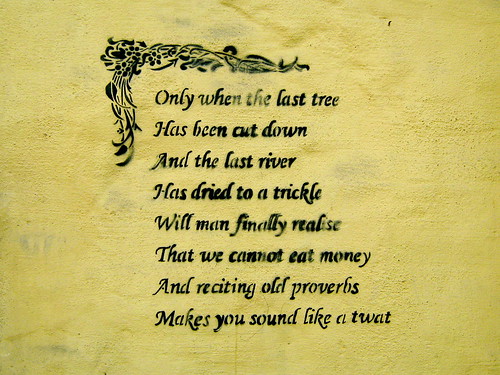
The piece I am discussing is work of Banksy, arguably the world-renowned street art / graffiti artist. In this work he uses a well-known Native American proverb and alters it to change the meaning – a signature method of the artist. Here he adds two new final lines to the poem that brutally break with the expectation the unsuspecting reader undoubtedly has of the proverb. In this analysis I will discuss the way the artist creates this effect on different layers and what his motivation might be.
First sign that something unusual is going is the context this piece appears: it is sprayed as a stencil print on a wall in the street. This is already the first level on which the artist mocks the general opinion of art and vandalism. The next step is the form he chooses. He uses an old-fashioned font and even uses adornments at the corners, such as found in old books. This makes it look beautiful and awe-inspiring – especially to conservative onlookers, who would commonly condemn it as vandalism. So again Banksy plays with the general expectation of graffiti and art. This combination of old, well-established elements with the quite modern form of graffiti / street art / stencil printing is characteristic for his work. He for instance commonly uses old-fashioned pictures of people for his guerrilla art attacks. This is undoubtedly an effective way to force the viewer to rethink his own ideas of art.

But now let us look at the content itself. I must admit, when I first saw the picture of this piece and didn't know it was the work of Banksy, I was unsure about its message. Obviously it criticizes either the use of the proverb or the proverb itself. In German there is spoof which goes more or less like “when the last gas-station has been closed, will we realize that we can't buy beer at Greenpeace in the middle of the night”. But of course it would be a rather sophisticated and intricate way, if it was just to mock environmental activism in general. No, someone who creates such an elaborate stencil and takes the risk of getting caught by the police must have some bigger idea in mind. Well, as soon a you know the man behind this work is Banksy, the intention becomes a lot clearer, especially when we take two other lines of his in account:
“Sometimes I feel so sick at the state of the world I can't even finish my second apple pie “
and
“We can't do anything to change the world until capitalism crumbles, In the meantime we should all go shopping to console ourselves.”
Both are featured along with his “Only when the last tree”-version in his book “Wall and Piece” and deliver the message somewhat clearer in my opinion. Banksy targets self-righteous, complacent pseudo-activism of today's mainstream intellectual youth. Everyone wants to change the hunger in the world, but no one wants to give up his own luxury goods (apple pies). Everyone wants the world to be more social, but since it's not going to happen any time soon (and also not without a substantial amount of sacrifice), people enjoy the comforts of capitalism and keep it alive that way. Banksy's “Only when the last tree” addresses a similar phenomenon. “Reciting old proverb” may sound sophisticated, but in the and it does not change a thing. But some people think they have already done their share just with sophisticated talk and that is what the artist criticizes. So in the end the thesis would be that “reciting old proverb” gives you false sense of accomplishment, which prevents you from taking some real action
In order to reach his target group Banksy once more plays with the expectations of his audience. But this time not with the public in general but rather with the young, educated and politically sophisticated people who agree with or even support environmentalist ideas, but leave it on a conversational level instead of taking action. This group of people would usually rather agree with the ideas of street art and not condemn it, so upon first sight they would probably agree with this proverb in its optically appealing way. You could even say if not for the last two lines spraying the proverb on a public wall instead of taking more effective actions would exactly be to “recite old proverbs”, which “makes you sound like a twat”. But of course there is a bigger idea behind it, as suspected.
It is not before the last line that the reader realizes that this is not another attempt of straight forward attempt of environmental activism. It even might not be before the last word that you realize that something is out-of-key here. “Twat” is a strong vulgar term that harshly breaks with the rather formal and solemn register of the original proverb, which is also maintained up until the last word. By doing so Banksy gives the reader a false sense of security only to deal him a blow to the head in the end. As I have pointed out earlier contrasts are a key element of Banksy's. Here he uses very strong contrasts to make people question their own ways.
Whether or not you agree in general with the artist - he certainly has a point here: Action speaks louder than words. But to close with a quotation by the Greek thinker Diogenes, which Banksy by the way also (approvingly) used in his work:
“One original thought is worth a thousand mindless quotings”.


p.s.
Now, after writing this analysis and making up my mind about Banksy instead of fighting the evils in the world, I feel a bit bad about that. I briefly thought about setting the nearest Starbucks franchise on fire, but then I actually realized that it would probably change as much as reciting old poems (which is nothing, but giving me a false sense of accomplishment) and I don't want to sound like a twat.
First pic via
Second www.banksy.co.uk
Abonnieren
Posts (Atom)