Samstag, 19. März 2011

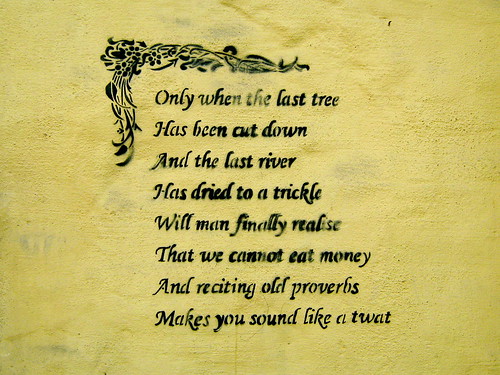
Banksy's "Only when the last tree"


The piece I am discussing is work of Banksy, arguably the world-renowned street art / graffiti artist. In this work he uses a well-known Native American proverb and alters it to change the meaning – a signature method of the artist. Here he adds two new final lines to the poem that brutally break with the expectation the unsuspecting reader undoubtedly has of the proverb. In this analysis I will discuss the way the artist creates this effect on different layers and what his motivation might be.


First sign that something unusual is going is the context this piece appears: it is sprayed as a stencil print on a wall in the street. This is already the first level on which the artist mocks the general opinion of art and vandalism. The next step is the form he chooses. He uses an old-fashioned font and even uses adornments at the corners, such as found in old books. This makes it look beautiful and awe-inspiring – especially to conservative onlookers, who would commonly condemn it as vandalism. So again Banksy plays with the general expectation of graffiti and art. This combination of old, well-established elements with the quite modern form of graffiti / street art / stencil printing is characteristic for his work. He for instance commonly uses old-fashioned pictures of people for his guerrilla art attacks. This is undoubtedly an effective way to force the viewer to rethink his own ideas of art.


But now let us look at the content itself. I must admit, when I first saw the picture of this piece and didn't know it was the work of Banksy, I was unsure about its message. Obviously it criticizes either the use of the proverb or the proverb itself. In German there is spoof which goes more or less like “when the last gas-station has been closed, will we realize that we can't buy beer at Greenpeace in the middle of the night”. But of course it would be a rather sophisticated and intricate way, if it was just to mock environmental activism in general. No, someone who creates such an elaborate stencil and takes the risk of getting caught by the police must have some bigger idea in mind. Well, as soon a you know the man behind this work is Banksy, the intention becomes a lot clearer, especially when we take two other lines of his in account:


Sometimes I feel so sick at the state of the world I can't even finish my second apple pie “


and


We can't do anything to change the world until capitalism crumbles, In the meantime we should all go shopping to console ourselves.”


Both are featured along with his “Only when the last tree”-version in his book “Wall and Piece” and deliver the message somewhat clearer in my opinion. Banksy targets self-righteous, complacent pseudo-activism of today's mainstream intellectual youth. Everyone wants to change the hunger in the world, but no one wants to give up his own luxury goods (apple pies). Everyone wants the world to be more social, but since it's not going to happen any time soon (and also not without a substantial amount of sacrifice), people enjoy the comforts of capitalism and keep it alive that way. Banksy's “Only when the last tree” addresses a similar phenomenon. “Reciting old proverb” may sound sophisticated, but in the and it does not change a thing. But some people think they have already done their share just with sophisticated talk and that is what the artist criticizes. So in the end the thesis would be that “reciting old proverb” gives you false sense of accomplishment, which prevents you from taking some real action


In order to reach his target group Banksy once more plays with the expectations of his audience. But this time not with the public in general but rather with the young, educated and politically sophisticated people who agree with or even support environmentalist ideas, but leave it on a conversational level instead of taking action. This group of people would usually rather agree with the ideas of street art and not condemn it, so upon first sight they would probably agree with this proverb in its optically appealing way. You could even say if not for the last two lines spraying the proverb on a public wall instead of taking more effective actions would exactly be to “recite old proverbs”, which “makes you sound like a twat”. But of course there is a bigger idea behind it, as suspected.


It is not before the last line that the reader realizes that this is not another attempt of straight forward attempt of environmental activism. It even might not be before the last word that you realize that something is out-of-key here. “Twat” is a strong vulgar term that harshly breaks with the rather formal and solemn register of the original proverb, which is also maintained up until the last word. By doing so Banksy gives the reader a false sense of security only to deal him a blow to the head in the end. As I have pointed out earlier contrasts are a key element of Banksy's. Here he uses very strong contrasts to make people question their own ways.


Whether or not you agree in general with the artist - he certainly has a point here: Action speaks louder than words. But to close with a quotation by the Greek thinker Diogenes, which Banksy by the way also (approvingly) used in his work:


One original thought is worth a thousand mindless quotings”.


p.s.


Now, after writing this analysis and making up my mind about Banksy instead of fighting the evils in the world, I feel a bit bad about that. I briefly thought about setting the nearest Starbucks franchise on fire, but then I actually realized that it would probably change as much as reciting old poems (which is nothing, but giving me a false sense of accomplishment) and I don't want to sound like a twat.


First pic via

Second www.banksy.co.uk


Third pic via

Donnerstag, 17. März 2011

Marina Marina - Music in My Ears


Since we have been talking about the emotions that songs evoke in us when we listen to them (and of DIAMONDS), I am going to comment on this topic once again. I am the kind of person who finds the silence uncomfortable, when I’m not listening to music. Back when I lived at home my mum would try to get me to turn off my music when I was doing my homework, but she hardly ever succeeded. Especially the invention of teeny tiny mp3-players made her ardent task all the more difficult. Now that I live on my own (disregarding my roommate, who frankly does not care if I listen to music during my work as long as the base doesn’t knock her books off the shelves), music is with me every second of my life. Lately, I’ve been in love with a young woman of Welsh/Greek (exotic!) descent named Marina Diamandis whose artist name is Marina and the Diamonds. I especially love two of her songs: “Obsessions” and “I am not a Robot”. Especially the lyrics for “Obsessions” have a very special feel to them:

Sunday, wake up, give me a cigarette.
Last night's love affair is looking vulnerable in my bed
Silk sheet, blue dawn, Colgate, tongue warm
Won't you quit your crying? I can't sleep
One minute I'm a little sweetheart
And next minute you are an absolute creep

We've got obsessions
I want to wipe out all the sad ideas
that come to me when I am holding you
We've got obsessions
All you ever think about are sick ideas involving me, involving you

Supermarket, what packet of crackers to pick?
They're all the same, one brand, one name, but really they're not
Look, look, just choose something quick
People are staring, time to come quick in
Cheeks are on fire; just choose something, something, something
Pressure overwhelming
Next minute I am turning out of the door, facing one week without food
A day, a day when things are pretty bad
Don't let it make you feel sad,
the crackers were probably bad luck anyway
Can't let your cold heart be free
When you act like you've got an OCD

We've got obsessions
I want to erase every nasty thought
that bugs me every day of every week
We've got obsessions
You never tell me what it is
that makes you strong and what it is that makes you weak.

We've got obsessions
I want to erase every nasty thought
that bugs me every day of every week.
We've got obsessions
You never told me what it was
that made you strong and what it was that made you weak
Makes you weak, makes you weak,
make you weak, make you weak, make you weak
Make you

Sunday, wake up, give me a cigarette
Last night's love affair is looking vulnerable again


The way she just describes a banal situation like buying crackers and the stress that our daily obsessions may bring with it make me feel melancholic. Simple things in life can just stand in our way; mostly we cause those little things by ourselves. It’s us who make our relationships dysfunctional. It’s us, who hurt each other perpetually, not out of big emotions but out of laziness, lack of thoughtfulness. I feel that the line “Last night’s love affair is looking vulnerable in my bed” is enormously beautiful. It conveys a sense of fragility that lies in those short encounters, a sense of being able to hurt each other in moments of such emotional and physical proximity, even though we are two complete strangers. “I want to wipe out all the sad ideas that come to me when I am holding you” shows that she is clearly talking about a relationship that has gone down the gurgler already in which none of the partners is happy. Like “Hurt”, this song does not offer the slightest bit of consolation. There is no way out of this state of mutual disregard and disdain. Maybe just because they are to lazy, maybe because they have gotten used to each other, maybe because they are afraid of the world outside of their sterile little relationship bubble. Besides all this, the song is really beautiful, soundwise.
Enjoy:

Pic via

Rihanna's Redemption Song for Haiti

Covers of popular songs are everywhere on YouTube causing very strong emotional outbursts among the people who comment on them. Bob Marley’s „Redemption Song“ is over thirty years old and has been covered by many artists from‚ Stevie Wonder, Johnny Cash, Sinéad O’Connor and Chris Cornell, only to name the most famous of them. The latest cover version, however, is sung by pop singer Rihanna. She sang that song as part of her 2006 tour but recorded a new version of it in 2010. All profits from the sale of the single she donated to the Help for Haiti campaign. People might argue whether she has done a good job or tarnished the name of Bob Marley, but nevertheless, in the end she did something good by making her single a charity project. Although I love Bob Marley’s music and am not a big fan of Rihanna’s, she deserves some respect for carrying on a great artist’s legacy and helping people in need. So decide for yourself…


All I want for Christmas is a diamond


Apparently, I was one of the few people in class who didn't know about diamante poems. Since I'm very little into poetry and usually hate situations in which I'm asked to write a poem, I was surprised I liked this exercise quite a lot. Other people might have their difficulties with the clear-cut rules of diamante poems, but it helped me a lot. The suggested topic "Christmas" instantly caught my eye and helped me fight my initial fear of writing a poem. Christmas was the most fitting topic for my because, due to my first blog entry, it was not any problem at all to think of words. If anything, I had trouble to decide which words I want to use because I had so much of them in my head. I decided to write a poem with a simple structure, for I couldn't think of the opposite of Christmas. Again, not everyone will agree with the feeling I associate with Cristmas, but here is how I feel when the holiday season is near.


Christmas
festive, merry
celebrating, eating, presenting
Christmas brings people together
Holiday


Picture via

Mittwoch, 16. März 2011

Diamonds Are a Girl’s Best Friend


Who would have known that this saying also held true for Diamante poems? At least for me it was a really joyful task, since I felt that there was an endless stream of ideas bubbling out of me. For someone who knows writer’s blocks like the back of their hand, this was a remarkable experience. Especially the more complex poems that combined two diametrically opposed concepts in a symmetrical approach caught my eye. My plan was to create one of those poems, even though I knew that finding a sentence that went in the middle, and that marked the transition between the two concepts, would be exceptionally difficult. The first idea that popped into my mind was the good old love vs. hate. The interesting thing about those two, in my opinion, was the fact that they lie incredibly close together. For this reason, I decided that the concepts could probably be described by the same adjectives and participles; therefore, I set out to find those words that would fit both concepts.
Hate
Hot, strong
Simmering, burning, maddening
Oh, it’s just such an extremely fine line
Simmering, burning, maddening
Hot, strong
Love
I am still not quite content with the sentence in the middle, since it contains far too many words for my liking. However, in order to maintain the geometrical shape of a diamond, I had to add some filling words. My ideal version would have been “It’s such a fine line”. However, I can accept the version as it is, because I appreciate geometrical forms nice a math nerd with an OCD.

Here is the edited version:

Hate
Hot, strong
Simmering, burning, maddening
I  t  '  s     s  u  c  h     a     f  i  n  e     l  i  n  e

Maddening, burning, simmering
Strong, hot
Love
Picture via


Diamante poems


Time

Time
Precious, vital
Fleeting, Unending, Restricting
Crushes empires into Dust
Crippling, Killing, Seperating
Heartless, Merciless
Endbringer

Truth

Truth
Brutal, Bitter
Seeking, Avoiding, Defining
Don't Blame the Messanger
Honesty


The brainstorming part certainly helped me a lot to find a start. But it was a bit odd to look for certain parts of speech. Lots of phrases came to my mind and it was rather hard to narrow them down to a disctinct single word. All in all I dislike to have such a strict limitation of form, but it sure is a good exercise.

Pic via